
Del paisaje al cajón para las camisas: la casa Davies de Anshen & Allen como obra de arte total
Article Sidebar
Main Article Content
Abstract
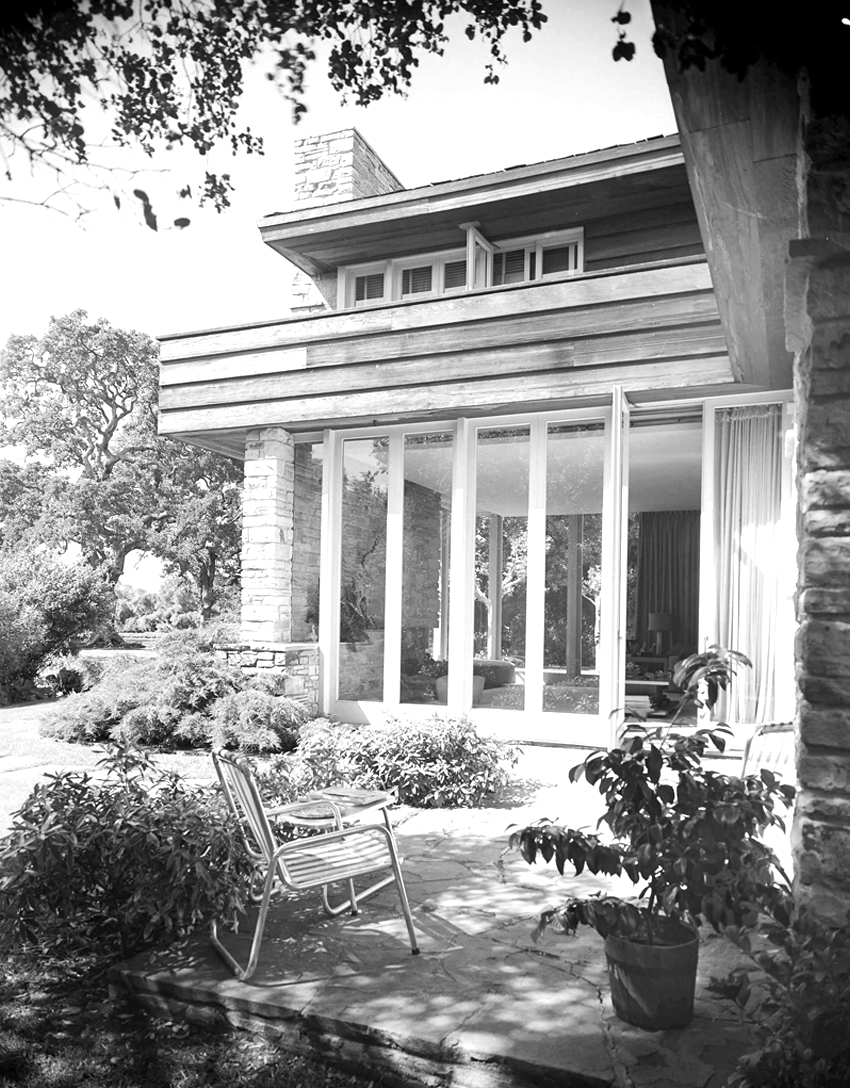
Anshen & Allen concibieron la casa Davies (Woodside, California; 1940-1941) como una síntesis entre arquitectura, paisaje y diseño interior. El proyecto tomó como punto de partida un jardín preexistente diseñado por Thomas Church y siguió una lógica de continuidad que se extendió hasta la producción artesanal del mobiliario. Este artículo examina la casa desde la perspectiva del arquitecto como diseñador integral, donde cada decisión formal, técnica y material se articuló como parte de un conjunto coherente. A partir de documentación inédita custodiada en los Environmental Design Archives (EDA) de UC Berkeley, se reconstruye el proceso de diseño de esta residencia como una ‘obra de arte total’, al tiempo que se plantea como punto de inflexión entre dos paradigmas: uno basado en la integración disciplinar y otro definido por la estandarización y la fragmentación del espacio doméstico en la arquitectura residencial de posguerra.
Downloads
Article Details

This work is licensed under a Creative Commons Attribution-NonCommercial-NoDerivatives 4.0 International License.
Authors who publish in this journal accept the following conditions:
•Authors retain copyright and assign the right of first publication to the journal, with the article registered under the Creative Commons attribution licence, which allows third parties to use the published material provided that they mention the authorship of the work and its publication in this journal.
•Authors may make other independent and additional contractual agreements for non-exclusive distribution of the preprint (the version submitted to the editor), the postprint (the version after peer review) and the version of the article published in this journal (e.g., to include it in an institutional repository or publish it in a book), provided that they clearly indicate that the work was first published in this journal. Authors are permitted and recommended to disseminate their work on the internet (for example, in institutional online archives or on their websites) after publication in Además de; this can produce interesting exchanges and increase citations of the published work (see The Effect of Open Access).
References
ALLEN, S., “Ralph K. Davies as I knew him”, in DAVIES, L. (coord.), Ralph K. Davies, as we knew him: biographical recollections and remembrances of R.K.D. as man and businessman, San Francisco, selfpublished, 1976, pp. 107-113. Available at Doe Library, University of California, Berkeley.
BARRY, J. A., “The graceful growth of a good house”, House Beautiful, no. 97, June 1955, pp. 86-91, 181.
BEHNE, A., Der moderne Zweckbau, Munich, Drei Masken Verlag A.G., 1926. Translated into English as The modern functional building, Santa Monica, The Getty Research Institute for the History of Art and the Humanities, 1996.
“Comfort produced by coordinated plan and equipment”, New Pencil Points, vol. 24, no. 10, October 1943, pp. 52-61.
FRAMPTON, K., Modern architecture: a critical history, London, Thames & Hudson, 1980.
FRAMPTON, K., Studies in tectonic culture: the poetics of construction in nineteenth and twentieth century architecture, Cambridge, Massachusetts, MIT Press, 1995.
GROPIUS, W., “Idee und Aufbau des Staatlichen Bauhauses Weimar”, 1923. Translated into English in BAYER, H., GROPIUS, W. and GROPIUS, I. (eds.), Bauhaus, 1919-1928, New York, The Museum of Modern Art, 1938.
KNOERLE, J., “Architect’s modernist legacy debated”, Almanac News [online], February 24, 1999 [https://www.almanacnews.com/morgue/1999/1999_02_24.adavies.html (last accessed April 11, 2025)].
LOWELL, W., “Interview with Derek Parker (1934-2023) at his home July 21, 2022. Taped and transcribed by Waverly Lowell”, Environmental Design Archives (EDA), University of California, Berkeley, 2022.
NORBERG-SCHULZ, C., Genius Loci: towards a phenomenology of architecture, New York, Rizzoli, 1980.
PALMER, S. and SUL, N. (eds.), Modernity in healing and learning: the architecture of Anshen+Allen, New York, Edizioni Press, 2007.
PARKER, D., Anshen + Allen: vignettes of an architectural practice, unpublished manuscript, 2022. Available at the Environmental Design Archives (EDA), University of California, Berkeley.
PARRA MARTÍNEZ, J. and CROSSE, J., “Exhibition as cultural struggle: domestic architecture of the San Francisco Bay Region (1949), between the question of regionalism and the International Style”, in CARAMELLINO, G. and DADOUR, S. (eds.), The housing project. Discourses, ideals, models and politics in 20th-century exhibitions, Louvain, Luven University Press, 2020, pp. 164–209.
PARRA MARTÍNEZ, J. and CROSSE, J., “SFMA, MoMA and the codification of Bay Region architecture (1935-1953)”, VLC arquitectura, vol. 6, no. 2, October 2019, pp. 1-26 [https://doi.org/10.4995/vlc.2019.10939].
RIESS, S. B., “‘Louise M. Davies. From Quincy to Woodside: Memories of Family and Friends’, an oral history conducted in 1983-1985 by Suzanne B. Riess”, Regional Oral History Office, The Bancroft Library, University of California, Berkeley, 1986.
SERRAINO, P., NorCalMod: Icons of Northen California Modernism, San Francisco, Chronicle Books, 2006.
TREIB, M. (ed.), Thomas Church, landscape architect: designing a modern California landscape, San Francisco, William Stout, 2003.
WIGLEY, M., “Whatever happened to total design?”, Harvard Design Magazine, no.5, Summer 1998 [https://www.harvarddesignmagazine.org/articles/whatever-happened-to-total-design/ (last accessed June 6, 2025)].
WOODBRIDGE, S. (ed.), Bay Area houses, New York, Oxford University Press, 1976.
ZITO, K., “$18 million, needs work / Davies home goes on the block as handyman’s special”, SFGATE [online], June 14, 2005 [https://www.sfgate.com/bayarea/article/18-million-needswork-Davies-home-goes-on-the-2662580.php (last accessed April 11, 2025)].