
Luigi Pellarin and Ubach, precursors of modernist mosaic
Article Sidebar
Main Article Content
Abstract
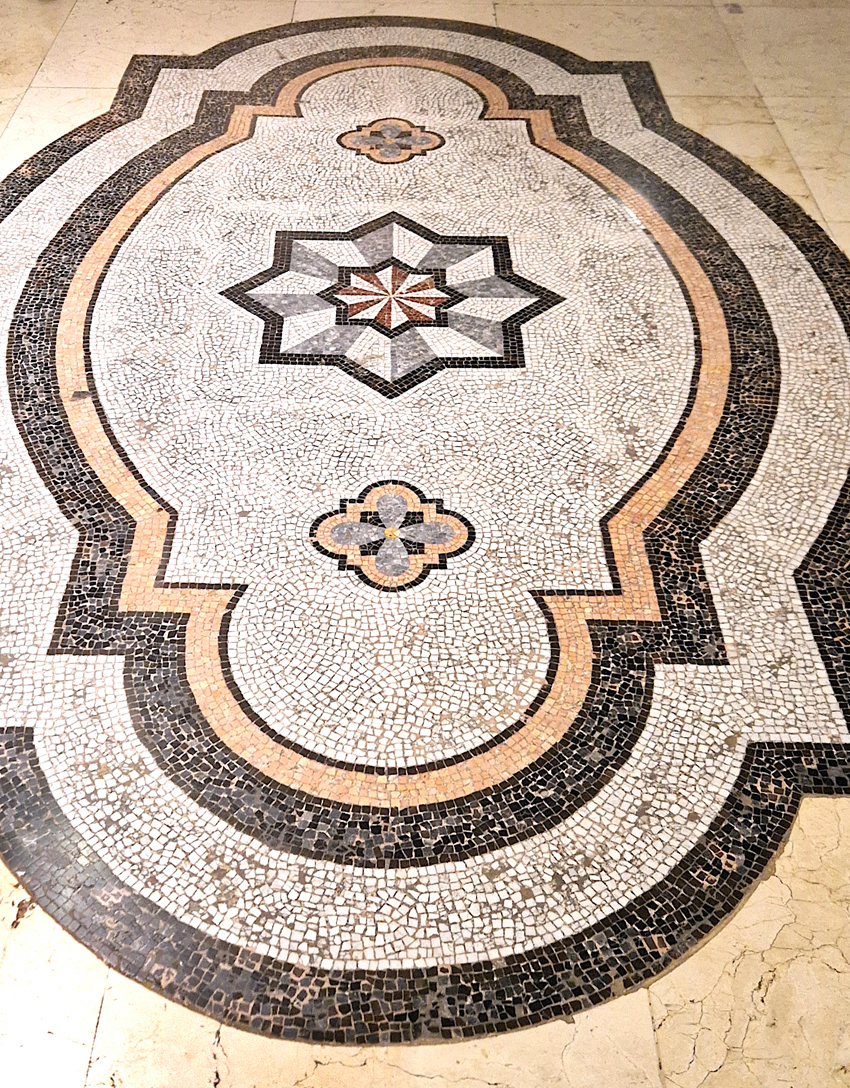
During the 19th century there was a gradual recovery of mosaics as a decorative technique. This process begins with the archaeological interest aroused by the Roman pavements discovered in excavations of classical origin and, in the second half of the 19th century, the discovery and revaluation of the Romanesque mosaics that covered the floors of medieval churches. This factor will be decisive in Catalonia, to give prestige to the mosaic as a decorative technique and adopt a nationalist character. In Barcelona, two figures very little documented, Josep Ubach and Luigi Pellarin will be responsible for introducing the modern mosaic to the city and laying the foundations for what it represented mosaically in modernism. In this period the continuous mosaic called the Venetian style stands out, which will disappear at the beginning of the 20th century, but which will be the previous step to the creation of Roman-style floor mosaics during the Art Nouveau period.
Downloads
Article Details

This work is licensed under a Creative Commons Attribution-NonCommercial-NoDerivatives 4.0 International License.
Authors who publish in this journal accept the following conditions:
•Authors retain copyright and assign the right of first publication to the journal, with the article registered under the Creative Commons attribution licence, which allows third parties to use the published material provided that they mention the authorship of the work and its publication in this journal.
•Authors may make other independent and additional contractual agreements for non-exclusive distribution of the preprint (the version submitted to the editor), the postprint (the version after peer review) and the version of the article published in this journal (e.g., to include it in an institutional repository or publish it in a book), provided that they clearly indicate that the work was first published in this journal. Authors are permitted and recommended to disseminate their work on the internet (for example, in institutional online archives or on their websites) after publication in Además de; this can produce interesting exchanges and increase citations of the published work (see The Effect of Open Access).
References
BARRAL I ALTET, X., Els mosaics medievals de Ripoll i de Cuixà, Abadía de Poblet, Scriptorium Populeti, vol. IV, 1971.
BARRAL I ALTET, X., Els mosaics de paviment medievals a Catalunya, Barcelona, Artestudi, 1979.
BARRAL I ALTET, X., “Un aspect du renouveau de la mosaïque en France au XIXe siècle: la découverte et la restauration des mosaïques médiévales”, Comptes rendus des séances de l'Académie des Inscriptions et Belles-Lettres, núm. 4, 1985, pp. 780-862 [DOI: https://doi.org/10.3406/crai.1985.14327 (Última consulta: 8 de octubre de 2024)].
BASSEGODA, J., El gran Gaudí, Sabadell, Editorial Ausa, 1989.
BINST, J. M., “Als alle stukjes samenvallen”, Bruzz, 22 de enero de 2020, pp. 22-23.
CARRERAS CANDI, F., La ciutat de Barcelona. Geografia General de Catalunya, Barcelona, Establecimiento editorial Albert Martin, s. d.
COLLEDANI, G., “Giandomenico Facchina: da Sequals a Parigi”, Il Barbacian, XXVI, 2, 1989, pp. 52-54.
DE EGUREN, J. M., Descripción del monumento erigido en Madrid para custodiar las cenizas de los excmos. señores Agustín Argüelles, Juan Álvarez y Mendizábal y José María Calatrava, Madrid, Imprenta de Gabriel Alhambra, 1857.
DE LA FUENTE, V., “Los mosaicos incrustados al fuego de Angel Anchisi, una pavimentación modernista olvidada”, Butlletí informatiu de ceràmica, núms. 117-118, 2018, pp. 28-37.
DE STEFANO ANDRYS, M., “Gian Domenico Facchina”, Il Barbacian, XXXVIII, julio de 2001, pp. 53-54.
DI POL, C., “I Pellarin di Sequals”, Il Barbacian, LVI, núm. 1, julio de 2019, pp. 72-76.
ERMACORA, M., “L’emigrazione friulana in Francia 1820-1914”, AMER, Archivio multimediale della memoria dell’emigrazione regionale, 9 de julio de 2013 [http://www.ammer-fvg.org].
FOLCH, Ll., Jose M. Folch y Torres, educador. Tesis doctoral, Barcelona, Universitat de Barcelona, 1969.
GROSSUTTI, J., “From Guild Artisans to Entrepreneurs: The Long Path of Italian Marble Mosaic and Terrazzo Craftsmen (16th c. Venice – 20th c. New York City)”, International Labor and Working-Class History, núm. 100, otoño de 2021, pp. 60–86 [DOI:10.1017/S0147547920000253].
GROSSUTTI, J., “Le ‘cementine’ oltreoceano: una tradizione italiana? Baldosas hidráulicas e mosaicos nel mondo ispano-americano”, en PERUSINI, G. y SDEGNO, A. (eds.). Con i colori dei marmi e il costo della terra. Le cementine: una storia di arte, architettura e artigianato. Udine, Forum, 2023, pp. 140-151.
PADROSA, I., La reforma de la iglesia y convento de Perelada (1875-1895), Perelada, Fundació Castell de Perelada, 2017.
PUGÈS, M., COLONNA-PRETI, K., “Mosaic de la sala d’actes de la Reial Acadèmia de Ciències i Arts de Barcelona”, en Anuari d'Arqueologia i Patrimoni. Barcelona, Ajuntament de Barcelona (en prensa).
ROSSELLÓ, M., “La definició dels interiors en l'arquitectura d'Elies Rogent: La Casa Arnús i la Casa Almirall", Espais interiors. Casa i art, Barcelona, Publicacions i Edicions de la Universitat de Barcelona, 2007, pp. 211-222.
RUBIO, A., “Decoración y mobiliario original del palacio del Congreso de los Diputados. Restauraciones, transformaciones y nuevas obras a lo largo de la segunda mitad del siglo XIX”, en Actas Congreso internacional de artes decorativas en instituciones parlamentarias, 1 y 2 de marzo de 2023, Madrid, Madrid, Congreso de los Diputados-Dirección de Estudios, Análisis y Publicaciones-Departamento de Archivo, 2023, pp. 133-170.
SALINÉ, M., El Mosaic Modernista a Catalunya (1888-1929), de la mà de Lluís Brú i Salelles i l’obra de Lluís Domènech i Montaner, Tesis doctoral, Barcelona, Universitat de Barcelona, 2015.
USCATESCU, A., Grandes de España, académicos, Mérimée y el mosaico tardo antiguo de Carabanchel”, Anales de Estudios Madrileños, vol. LVI, 2017, pp. 443-471.
VOCCOLI, O., La rinascita dell'arte musiva in epoca moderna in Europa. La tradizione del mosaico in Italia, in Spagna e in Inghilterra. Tesis doctoral. Barcelona, Universitat de Barcelona, 2010.
ZECCHINON, L., “Angelo Pellarin”, Il Barbacian, LIV, núm. 2, diciembre de 2017, pp. 17-21.