
The enigma of the material. Case study: the problem of morphological analysis for the identification of the species on an ivory plate
Article Sidebar
Main Article Content
Abstract
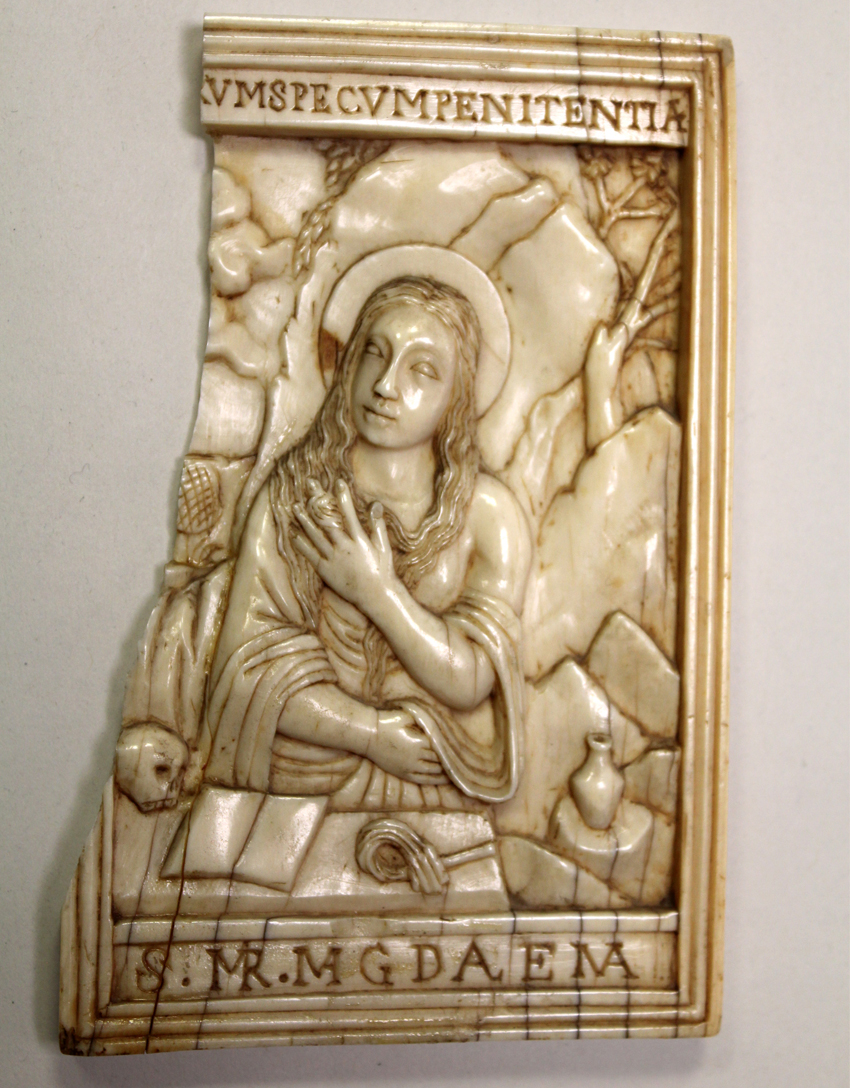
Study of an ivory piece from the National Museum of Decorative Arts in Madrid, analysing the origin of its material, in addition to its function and iconography. The objective is to give context to the possible identification of the animal from which the piece comes by analysing the Schreger lines to know if it is a piece made of mammoth or elephant ivory.
From a first visual analysis, a development of the particularities of the pattern according to animal and the difference between species is made. A conclusion is reached that an iconographic and morphological analysis is not sufficient for its identification and must be complemented with other technical analytical methods such as portable Raman spectroscopy, with an excitation wavelength of 758nm. The main ivory bands are observed in Raman spectra, highlighting the one centered at 1070 cm-1 that allows the differentiation of African, Asian and mammoth elephant ivories.
Downloads
Article Details

This work is licensed under a Creative Commons Attribution-NonCommercial-NoDerivatives 4.0 International License.
Authors who publish in this journal accept the following conditions:
•Authors retain copyright and assign the right of first publication to the journal, with the article registered under the Creative Commons attribution licence, which allows third parties to use the published material provided that they mention the authorship of the work and its publication in this journal.
•Authors may make other independent and additional contractual agreements for non-exclusive distribution of the preprint (the version submitted to the editor), the postprint (the version after peer review) and the version of the article published in this journal (e.g., to include it in an institutional repository or publish it in a book), provided that they clearly indicate that the work was first published in this journal. Authors are permitted and recommended to disseminate their work on the internet (for example, in institutional online archives or on their websites) after publication in Además de; this can produce interesting exchanges and increase citations of the published work (see The Effect of Open Access).
References
BAKER, B., JACOBS, R., MANN, M., ESPINOZA, E. y GREIN, G., Guía de identificación de la CITES del marfil y sus sustitutos (4ª ed., ALLAN, C. (ed.). World Wildlife Fund Inc., Washington DC, 2020. Disponible en: https://cites.org/sites/default/files/ID_Manuals/Identification_Guide_for_Ivory_and_Ivory_Substitutes_SPANISH.pdf [última consulta: 1-9-2024].
BURACK, B., Ivory and Its uses, Tokyo, Charles E. Tuttle Company,1984.
CABAÑAS MORENO, M. del P., Marfiles japoneses en las colecciones españolas, Tesis doctoral inédita, Madrid, Universidad Complutense de Madrid, 1993.
CARTIER, L., KRZEMNICKI M. S., GYSI, M., LENDVAY, B. y MORF, N. V, “A Case Study of Ivory Species Identification Using a Combination of Morphological, Gemmological and Genetic Methods”, Journal of Gemmology, vol. 37, núm. 3, 2020, pp. 282-297 [https://doi.org/10.15506/jog.2020.37.3.282].
CASADO PARAMIO, J. M., Museo Oriental de Valladolid. Catálogo II. Marfiles hispano-filipinos, Valladolid, Caja España, 1997.
DEL AMO HORGA, L.M., “María Magdalena, la Apostola Apostolorum”, en AA.VV., El culto a los santos: cofradías, devoción, fiestas y arte, San Lorenzo de El Escorial, Ediciones Escurialenses: Real Centro Universitario Escorial-María Cristina, 2008, pp. 613-636.
ECHEVERRÍA, J. M., Coleccionismo de marfiles, León, Editorial Everest, 1980.
EDWARDS, H. G. M., BRODY, R. H., HASSAN, N. F. N., FARWELL, D. W. y O’CONNOR, S., “Identification of archaeological ivories using FT-Raman spectroscopy”, Analytica Chimica Acta, vol. 559, núm. 1, 2006, pp. 64-72 [https://doi.org/10.1016/j.aca.2005.11.067].
EDWARDS, H. G. M., FARWELL, D. W., HOLDER, J. M. y LAWSON E. E., “Fourier transform-Raman spectroscopy of ivory: a non-destructive diagnostic technique”. Studies in conservation, vol. 43, núm 1, 1998, pp. 9-16 [https://doi.org/10.1179/sic.1998.43.1.9].
ESPINOZA, E. O. y MANN, M.-J., “The History and Significance of the Schreger Pattern in Proboscidean Ivory Characterization”, Journal of the American Institute for Conservation, vol. 32, núm. 3, 1993, pp. 241-248 [https://doi.org/10.1179/019713693806124866].
ESTELLA MARCOS, M. M., La escultura de marfil en España. Escuelas europeas y coloniales, Madrid, CSIC, 1984, 2 vols.
ESTELLA MARCOS, M. M., La escultura de marfil en España: románica y gótica, Madrid, Editora Nacional, 1984.
JOHNSSON, K., “Chemical dating of bones based on diagenetic changes in bone apatite”, Journal of Archaeological Science, vol. 24, núm. 5, 1997, pp. 431-437 [https://doi.org/10.1006/jasc.1996.0127].
LE GUENNEC, Y., “African Elephant Ivory Subspecies Differentiation by Raman, FTIR and UV-Vis Spectroscopic Analysis”, 2020, pp. 1-20 [https://doi.org/10.13140/RG.2.2.26009.65125].
LOCKE, M., “Structure of ivory”, Journal of Morphology, vol. 269, núm. 4, 2008, pp. 423-450 [https://doi.org/10.1002/jmor.10585].
LOCKE, M., Bone, Ivory and Horn. Identifying Natural Materials, Atglen, Schiffer, 2013.
LONG, D. N., EDWARDS H. G. M. y FARWELL, D. W., “The Goodmanham plane: Raman spectroscopic analysis of a Roman ivory artefact”, Journal of Raman Spectroscopy, vol. 39, núm. 3, 2008, pp. 322-330 [https://doi.org/10.1002/jrs.1949].
MARTÍNEZ GUISASOLA, J. M., “Magdalena”, en PAVÓN TORREJÓN, P. (coord.), 250 mujeres de la Antigua Roma, Sevilla, Universidad de Sevilla, 2022, pp. 115-116.
PALOMBO, M. R. y VILLA, P., “Schreger Lines as Support in the Elephantinae Identification”, en CAVARRETTA, G., GIOIA, P., MUSSI, M. y PALOMBO, M. R. (coords.), La Terra degli Elefanti. Atti del 1º Congresso Internazionale - The World of Elephants: Proceedings of the 1st International Congress, Roma, 2001, pp. 656–660.
PARUNGAO, D., VANDENABEELE, P., EDWARDS, H. G. M., CANDEIAS, A. y MIGUEL, C., “Mobile Raman spectroscopy analysis of elephant ivory objects”, Journal of Raman Spectroscopy, 2022 [https://doi.org/10.1002/jrs.6487].
SÁNCHEZ MORILLAS, B., María Magdalena, de testigo presencial a icono de penitencia en la pintura de los siglos XIV-XVII, Tesis doctoral inédita, Sevilla, Universidad de Sevilla, 2014.
VIRÁG, A. “Histogenesis of the Unique Morphology of Proboscidean Ivory”, Journal of Morphology, vol. 273, núm. 12, 2012, pp. 1406-1423 [https://doi.org/10.1002/jmor.20069].
FARIA, F. (coord.), Portuguese Expansion overseas and the art of Ivory, Lisboa, Calouste Gulbenkian Foundation, 1991.
VOLLRATH, F., MI, R. y SHAH, D. U., “Ivory as an Important Model Bio‐composite”, Curator: The Museum Journal, vol. 61, no 1, 2018, pp. 95-110 [https://doi.org/10.1111/cura.12236].